

Loneliness
Mark 1:40-2:5 | 1: The Way to Begin Again | Scene 6

A man with leprosy came to him and begged him on his knees, “If you are willing, you can make me clean.”

Jesus was indignant. He reached out his hand and touched the man. “I am willing,” he said. “Be clean!” Immediately the leprosy left him, and he was cleansed.

Jesus sent him away at once with a strong warning: “See that you don’t tell this to anyone. But go, show yourself to the priest and offer the sacrifices that Moses commanded for your cleansing, as a testimony to them.”

Instead, he went out and began to talk freely, spreading the news. As a result, Jesus could no longer enter a town openly but stayed outside in lonely places. Yet the people still came to him from everywhere.

A few days later, when Jesus again entered Capernaum, the people heard that he had come home.

They gathered in such large numbers that there was no room left, not even outside the door, and he preached the word to them.

Some men came, bringing to him a paralyzed man, carried by four of them.
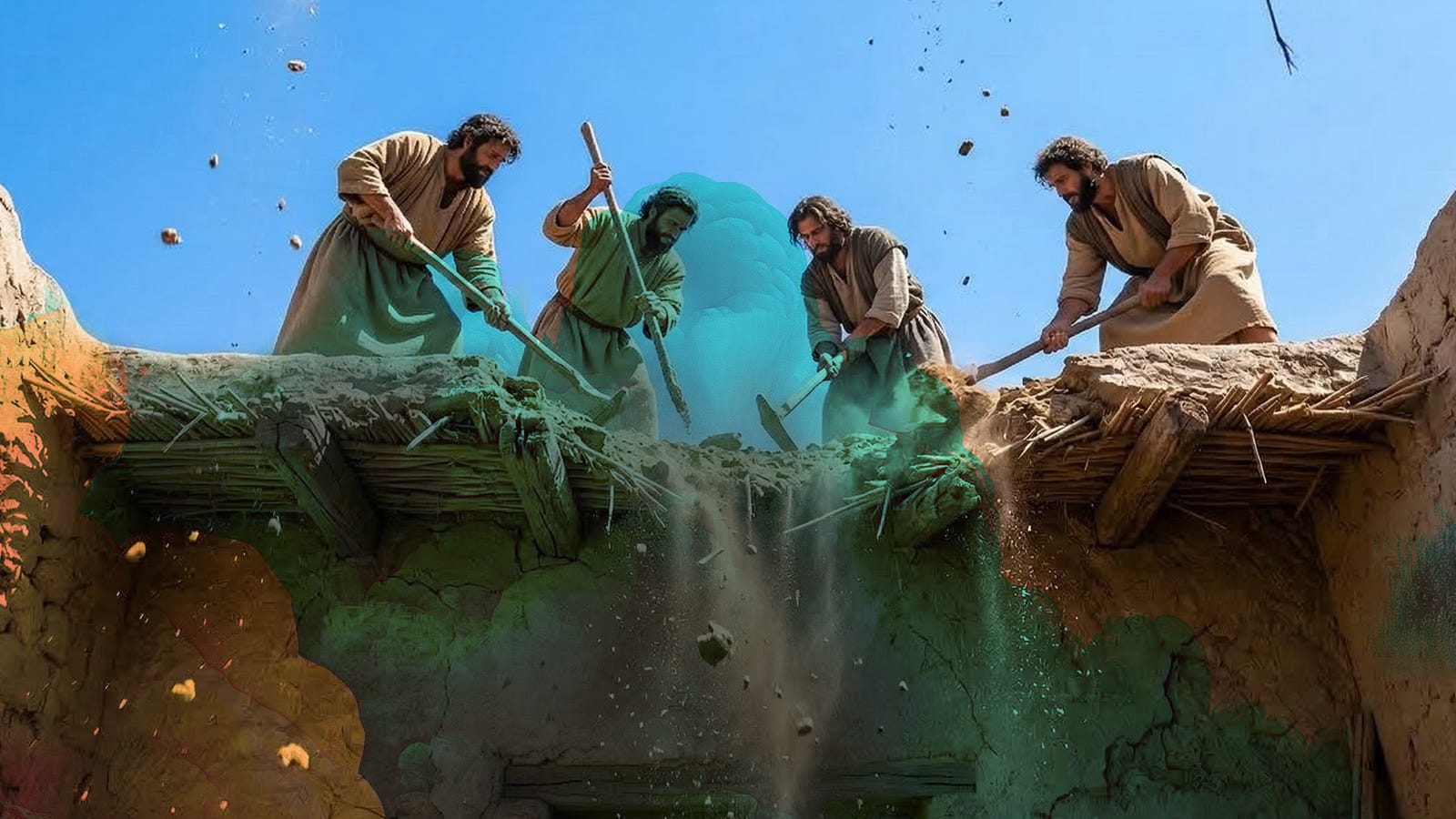
Since they could not get him to Jesus because of the crowd, they made an opening in the roof above Jesus by digging through it and then lowered the mat the man was lying on.

When Jesus saw their faith, he said to the paralyzed man, “Son, your sins are forgiven.”
 - Mark 1:40-2:5
A house in Capernaum, standing room only. Jesus is inside, teaching. The crowd spills out the door and into the courtyard, blocking the street.
Four men approach, carrying their friend on a mat. The man on the mat is paralyzed. They try to approach the door, but there’s just too many people. They try calling out and pushing forward. Impossible.
One of them has an idea. They carry him around to the side of the house, where external stairs lead to the flat roof. Up they go—one man at each corner of the mat, careful not to jostle their friend.
On the roof, they start digging. The roof is made of wooden beams covered with packed mud and thatch. They punch into the mud and tear at the thatch. Debris begins to fall into the room below. Jesus looks up and the crowd gasps. They make eye contact with the men above him through the jagged hole.
Emboldened, the four men keep digging. Then, carefully, they lower their friend down through the ceiling, right in front of Jesus.
Frankly, it’s difficult for me to imagine such a loving act by four friends today. In fact, some have said we are living in an epidemic of loneliness.
Whether because of technology, social upheaval, or just the vagaries of modern life, we have become cautious about having friends—and unsure how to be one. Many of us don’t even know what true friendship looks like anymore.
Experts now say loneliness is as dangerous to your health as smoking. Because of technology, we are supposedly more connected than ever, but ironically, many of us feel unseen. Unneeded. Unknown.
Christian author Alan Noble argues that “you’re on your own” is the foundational lie of modernity. We’ve built entire industries around self-sufficiency: self-help, self-care, self-optimization. The message is clear: You shouldn’t need anyone.
But the cost is staggering. Until we reject this lie and recover the truth that we belong to God and to each other—not just to ourselves—we’ll keep slapping Band-Aids on a wound that needs surgery.
I know what it feels like to be surrounded by people but still alone.
My junior year of high school, I had two close friend groups—some classmates and my sister’s friends who were students at the local junior college. We did everything together. Movies, concerts, late-night conversations about life and faith and what we’d do after graduation.
Then, at the end of the year, everything fell apart. Relationship breakups destroyed my classmate group—the kind of messy drama where choosing sides meant losing friends. And some of my sister’s college friends moved on to other adventures, scattering across the state.
So at the beginning of my senior year, I found myself with no one to hang out with.
I tried. I reached out to acquaintances from throughout my years in school. I said yes to invitations. I showed up at parties. I sat at lunch tables with people I barely knew.
But they didn’t like the same things I liked. Didn’t share the same values. Didn’t care about the things that mattered to me. I was in the room, but I wasn’t really there. I wasn’t alone, but I was profoundly lonely.
The worst part? I felt like it was my fault. Like if I were more interesting, more fun, more something, I’d have real friends. So I kept trying to manage it. Kept smiling. Kept pretending it was fine.
But life felt emptier than it should have. Smaller than it was meant to be.
I didn’t have language for it then, but what I needed wasn’t more effort. What I needed was to stop carrying the weight of loneliness alone and admit: I can’t fix this by myself. I need help.
There’s a particular kind of loneliness that comes from believing you have to do everything yourself. Not the loneliness of being physically alone—but the isolation of carrying burdens solo, even when surrounded by people.
This story challenges that assumption at its core.
Before the mat incident, a man with leprosy approaches Jesus alone. Leprosy, or what we call Hansen’s disease today, required isolation. Lepers were required to live outside the community, to call out “Unclean!” if anyone approached, and to cover their faces and keep their distance.
But this leper broke the rules. He came close enough to kneel before Jesus. Then he says something remarkable: “If you are willing, you can make me clean.”
Notice: He doesn’t doubt Jesus’ power. He questions Jesus’ willingness, perhaps because the conventional social response by Jesus would have been to reject him for even coming close.
Mark tells us Jesus was indignant, not at the leper, but at whatever had convinced this man that Jesus might not be willing to heal him. At a religious system that had taught him God’s love was conditional. At a society that had isolated him so thoroughly that he had to wonder if even the Messiah would reject him.
And so he does the unthinkable: he reaches out and makes contact. No hesitation. No ritual precautions. Just a simple response: “I am willing.”
No one touched lepers. Yet Jesus reaches out, makes physical contact with someone ritually unclean and terrifyingly contagious, and says the words the man desperately needed to hear.
The man came alone, but he left both clean and seen.
The paralyzed man’s story couldn’t be more different. He is not alone; he has friends. He just can’t get up. He can’t go to Jesus, so his friends carry him. And the friends – what friends they are! When the crowd blocks the door, they don’t give up. They tear apart the boundary between outside and inside, between public and private.
Now, they stand in front of Jesus. The debris has settled, save for a few wisps coasting down from the above. In the air of shock, Jesus says something that stops everyone: “Son, your sins are forgiven.”
The scribes in the room bristle. They’re trained Torah scholars who’d devoted their lives to understanding God’s law. Judaism taught that only God could forgive sins. Yes, a priest could declare sins forgiven after proper sacrifice at the temple. A prophet could announce God’s forgiveness. But to simply enact forgiveness, as if you yourself possessed divine authority?
That was blasphemy. A capital offense.
But Jesus is doing more than healing. He’s revealing that the paralysis we can see is connected to the brokenness we can’t. Physical wholeness and spiritual restoration are both part of God’s kingdom breaking in.
The two healings together reveal the rhythm of kingdom life.
Sometimes we come to Jesus alone in our desperation. And sometimes we can’t come at all, which is why we need friends willing to carry us, to tear through obstacles, to refuse to give up until we’re in Jesus’ presence.
You weren’t made to walk alone. The lie says asking for help is weakness, that needing others means you’ve failed. But the truth is God gives you friends to carry you when you can’t walk and calls you to carry others when they can’t stand.
Our final story of season one is one of the most beautiful pictures of friendship in all the Scriptures. Loneliness begins to break when we gather with friends in Jesus’ home. This story is the perfect picture of community:
A crowded house.
Friends refusing to give up.
Jesus in the center.
Healing that begins when we stop going it alone.
That’s the heartbeat of this story—and of Jesus’ whole ministry, really. He doesn’t just heal individuals. He restores community. When we gather in His presence, loneliness loses its power and community becomes the agent of healing.
The way of Jesus offers something radically hopeful: You don’t have to do life alone.
The leper came alone, desperate and doubting if Jesus would even want him. Jesus touched him.
The paralytic couldn’t come at all. His friends carried him through the roof. Jesus forgave him.
Whether you come alone or need to be carried, Jesus sees you. And he’s willing.
The Lie: Anything good that happens is the result of me doing it myself.
The Wound: “Am I really on my own in life?”
The Real Issue: I feel isolated and unsupported.
The Truth: God gives me friends to carry me—and calls me to carry others.
Pray
Lord, thank you for the gift of friendship. Open my heart to find people near me who could use a friend or be a friend. Give me courage to take the first step and reach out, and the willingness to respond. Amen.
Live It
Name three people. Make a list of people you see often but don’t really know. Send one of them a message today. Just ask how they’re doing. Don’t offer advice. Just listen.
If you’re feeling lonely today: Pause and pray, “Jesus, send me someone to help carry my mat.”
Be a roof-digger: Who in your life might be paralyzed by something right now—depression, grief, exhaustion, loss? What would it look like to carry them to Jesus this week? Not to fix them, but to show up and refuse to give up on them.
Where We Are: Season 1 | Scene 6 of 6 | Day 1 of 6