

The Problem With Adding Jesus | Mark 2:18-22
The Way to Trust | Scene 3, Day 2 | Mark 2:18-22

Now John’s disciples and the Pharisees were fasting. Some people came and asked Jesus, “How is it that John’s disciples and the disciples of the Pharisees are fasting, but yours are not?”
Jesus answered, “How can the guests of the bridegroom fast while he is with them? They cannot, so long as they have him with them. But the time will come when the bridegroom will be taken from them, and on that day they will fast.
“No one sews a patch of unshrunk cloth on an old garment. Otherwise, the new piece will pull away from the old, making the tear worse.”
“And no one pours new wine into old wineskins. Otherwise, the wine will burst the skins, and both the wine and the wineskins will be ruined. No, they pour new wine into new wineskins.”
Mark 2:18-22
It is now the third time they have confronted Jesus, and their pestering seems increasingly less like curiosity and more like accusation.
A group of religious observers—perhaps the same ones, we don’t know—approaches Jesus with another question. But the question has an edge:
John’s disciples fast, they say. Our disciples fast. Why don’t yours?
Fasting was serious business in first-century Judaism—a sign of mourning, repentance, or urgent petition before God. The law required it only on the Day of Atonement, but Jewish tradition had added many others. The Pharisees fasted twice a week. John’s disciples fasted as part of their desert asceticism, a lifestyle of radical preparation for God’s coming. Fasting was a way to express that “things are not right and we’re waiting for God to act.”
When people notice Jesus’ disciples aren’t fasting, it’s not a minor detail.
Jesus doesn’t give them a direct answer. Instead, he answers a question with another question: “How can the guests of the bridegroom fast while he is with them?”
Then he shifts to an analogy that sounds almost violent. Old cloth and new patches. Old wineskins and new wine. Things that can’t be forced together without tearing, bursting, destroying.
His metaphors are visceral, but his meaning is clear to those with ears to hear. He’s talking about himself.
The Pharisees are asking a question about rules, which reminds me of my first car.
When it came time for me to drive in the spring of 1987, I told my dad I wanted a Pontiac Fiero, or maybe an old muscle car from the late ‘60s. I didn’t dream small.
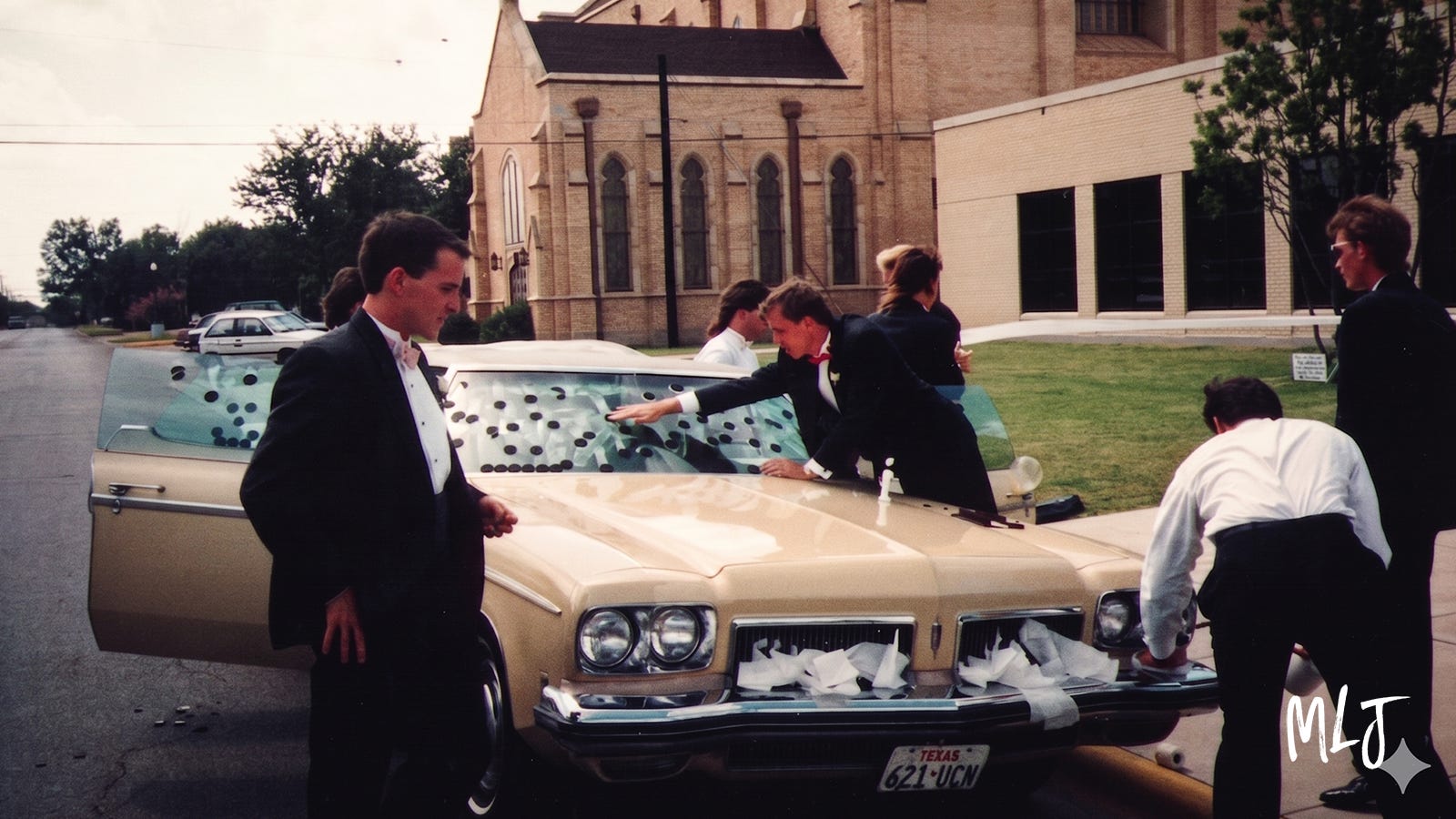
Dad was a chaplain by then, but he still parented like a Lieutenant Colonel. One day he came back with a car he’d arranged for me: a big, yellow 1973 Oldsmobile Delta 88. An old lady car. 14 years old and only 32,000 miles, he said.
I called it the banana boat.
He told me it was going to cost me $1,850. We co-signed a loan, and I started making payments with my grocery store bagger wages. There was no arguing about it; this was my car. So I decided to go all in.
I quickly discovered that driving a big car from the early ‘70s had benefits. It only got 15 miles per gallon, but it went fast. It may not have looked the coolest, but with all the windows down, it almost felt like a convertible.
After a couple of weeks of driving the normal route to school, I discovered Nugent Road, a back way with no curbs and some rolling hills. I also discovered that if you went 90 miles an hour over one of those hills, you could catch a little air.
I was a good kid. Didn’t drink or smoke, got straight As. I accepted the banana boat and I paid for it. I drove it for six solid years through college until I sold it for $1,350—the cheapest wheels I’ll ever own. Credit to my dad for finding it.
But I was also a bit of a rebel. I liked to push it, take corners too fast, and achieve liftoff on the low hills around my neighborhood.
All of that to say: my driving reflected my life. I was living inside a strict moral code. Sort of rebelling against it, but not really. Living with choices I’d made and been given but still seeking something real. Something that said, this is life.
The tension of living with rules while also pushing boundaries defined my younger years. I grew up thinking of Christianity as a moral framework. My mom was raised General Baptist, a faith tradition good at following rules. My dad was a Methodist pastor, more pragmatic but still serious about right behavior.
But I also loved rock and roll. I drove too fast. I pushed against the edges.
I wasn’t truly rebellious; I was too grounded in my parents’ faith for that. But I was uncomfortable. The moral code felt restrictive. Not terrible, but kind of like the banana boat: functional, safe, even something occasionally approaching fun, yet not what I would have chosen.
For years, I thought the problem with my lack of enthusiasm about my parents’ religion was me. If I could just be good enough, if I could just follow the rules better, then I’d experience the abundant life Jesus talked about.
But a part of me wondered, what if being good isn’t the point of life?
When Jesus answers the Pharisees, he isn’t rejecting fasting, per se. As he is so good at doing, he’s redefining the terms of the conversation. He’s actually saying something more radical.
Calling himself the “bridegroom” would have stopped everyone cold. Every Jew knew this language. Throughout the prophets, God called himself Israel’s husband. When Israel worshiped other gods, the prophets called it adultery.
So for Jesus to claim he’s the bridegroom is messianic. He is saying, I am God come to claim my bride.
The implication is staggering to the Pharisees. He is saying, your long-awaited wedding isn’t someday in the distant future; it is right now. The bridegroom is here and the celebration has begun.
Then he tells two parables about patches and wineskins. His point: you can’t just add Jesus to your existing religious system. He’s not an upgrade or enhancement, some sort of cosmic pro-tip dispenser.
He’s creating something entirely new—unprecedented, never before seen. Jesus isn’t patching up the old covenant. He’s inaugurating a new creation.
Jesus is saying what took me decades to fully understand: Christianity is not a moral framework. When Jesus calls himself the bridegroom—claiming to be God—he doesn’t leave middle ground. Either he’s delusional, demonic, or divine. When someone claims to be God, there’s no “great moral teacher” option.
Likewise, there’s no “helpful addition to my existing life” option.
This is why Jesus talks about patches and wineskins. He’s saying: What I’m bringing doesn’t fit into your old categories. Your old ways of thinking. Your old patterns of living.
Old wineskins, already stretched from previous fermentation, can’t handle new wine. The gases from fresh fermentation will stretch them further, bursting them. You lose both wine and wineskin. New wine requires new wineskins—containers with flexibility, room to expand.
Jesus is saying the kingdom he brings cannot be contained in old religious structures. The Pharisees’ system—with its purity boundaries, Sabbath regulations, and intense fasting schedules— served its purpose. But what I bring is alive, fermenting, expanding. It will burst those old containers.
You can’t pour kingdom life into law-keeping religion. The new wine needs new forms: communities that eat with sinners, Sabbaths that prioritize people over rules, holiness that spreads through contact. If you try to fit Jesus into your existing life, one of two things happens: either Jesus gets domesticated into something powerless, or your entire life changes.
There’s no third option.
If you take Jesus’ words seriously, he is either the Son of God, or He isn’t. There’s no middle ground. Which means that when you decide to follow Jesus, He doesn’t just adjust or improve your life. He redefines it entirely.
I drove the banana boat for six years. I made it work. I even grew to love it. It wasn’t what I would have chosen, but I am glad I owned it. In fact, I still have an occasional dream about it, which my wife finds hilarious.
For a long time, I treated Christianity the same way. I made it work. I followed the rules, sometimes. I came to appreciate it. I thought if I could just get the moral code right, I’d find the life Jesus promised. But something was missing. What I didn’t understand was that Jesus wasn’t offering me a better moral code. He was offering Himself.
A Person to know, not a system to follow.
So here’s the question this story raises: Are you trying to fit Jesus into your life, or are you willing to let him rebuild your life entirely? Because Jesus isn’t one option among many. He’s not a helpful addition to an otherwise self-directed existence. He’s the bridegroom claiming his bride. He’s the new creation breaking into the old.
He’s Lord—which means he doesn’t fit into your existing plans.
He creates new ones.
Pray
Lord, forgive me for trying to fit you into my existing life. I don’t want Jesus as an addition—I want you as Lord. Tear apart whatever needs tearing so I can receive what you’re offering. Amen.
Nice article, thanks for sharing. It's clear (with eyes to See) by the things He did and said that Jesus is God. He's the Son of God by virtue of His humanity, sired by the Holy Spirit. But He's also GOD.