

Politicking | Mark 3:6
The Way to Trust | Scene 5, Day 5 | Mark 3:6

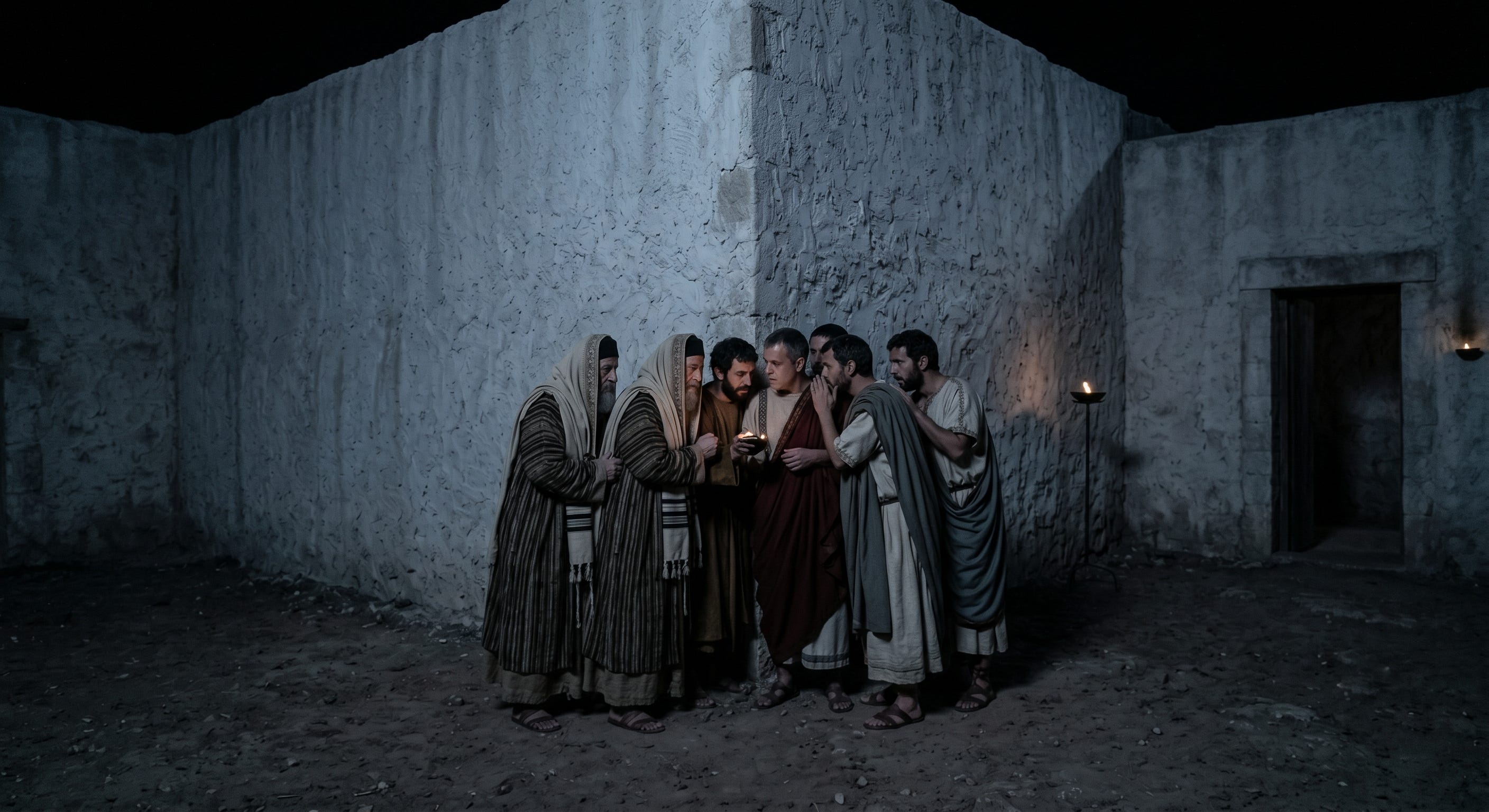
Then the Pharisees went out and began to plot with the Herodians how they might kill Jesus.
Mark 3:6
Geez Louise, kill him?
Isn’t that a bit of an overreaction? All of the plotting and politicking…
The political landscape in Jesus’ day was pretty complicated. Several groups had emerged, each with their own ideas and strategies. Here is a quick rundown:
● The Sadducees were the wealthy, powerful elite. They worked with the Romans and controlled Temple activities. They didn’t believe in angels or resurrection—instead, they were focused on the here and now. They were also smooth operators.
● The Pharisees were policy wonks, known for strict adherence to the law. They were passionate about what was right. Largely lawyers and scholars, they interpreted Jewish law and taught in synagogues. At the time, they were part of a reform movement committed to extending temple purity into everyday life, making all of Israel holy through careful observance of law and tradition. Jesus likely came from this “tribe”, though he eventually clashed with them.
● The Herodians supported King Herod and Roman rule. They were political collaborators—Jews who supported Herod family rule and, by extension, Roman occupation. They were the opposite of the Pharisees in almost every way. Pharisees wanted religious purity and resisted Roman influence. Herodians wanted political stability and embraced Roman power.
● The Zealots were revolutionaries, pushing for violent rebellion against Rome. They were inspired by the Maccabees, who had fought off foreign rulers generations earlier. Forty years later, they managed to start a war with the Romans. It didn’t end well, but that didn’t seem to dissuade them.
● The Sicarii were an even more extreme subgroup of the Zealots. They were assassins who carried small daggers and killed people they saw as Roman collaborators—even in crowded marketplaces.
● The Essenes were the ascetics, staying away from Temple politics altogether. Some think John the Baptist’s followers were Essenes, but there’s little solid evidence for that.
Each group thought they knew best.
Of course, not everyone was part of a political party. Some people were just trying to get through the day.
Invite Press author Robert Glenn Johnson points out that five distinct groups became enemies of Jesus: the Sadducees, Pharisees, Herodians, John the Baptist’s disciples, and even his own family.[i] Pretty much that entire list, except maybe the zealots who were holding out hope that he would lead a revolution.
That’s a lot of opposition.
Some of it was personal. The Pharisees, John’s disciples, and Jesus’ family had disagreements with him. If you’ve ever had a tense holiday dinner, take heart—Jesus knows what that’s like.
Still, plotting to kill him over disagreements seems extreme, doesn’t it?
Maybe not. If you consider the way some people thought—what we will later learn as “the way of the world”—murder may have been seen as a necessary evil in order to avoid an even worse outcome: losing control.
We’ve already seen that some of Jesus’ enemies weren’t willing to stand up, become vulnerable, and confront their own flaws like the man with the shriveled hand. Instead, they opted for a darker path.
When livelihoods and power are at stake, people do drastic things.
You can almost hear their fear and desperation in their reaction: misinformation must be silenced!
So, the Pharisees approach the Herodians and hatch a plot to kill Jesus.
Perhaps this is why Jesus was so deeply distressed in the previous verse. He knew the consequences of his decision to heal the man, yet he did it anyway.
We’ve come to the first major plot turn of our story: a plot to murder.
It hurts my heart to write this. I imagine Jesus trying to teach and heal, only to face resistance that escalated to violence.
And yet, do we not see the same sort of animosity today? Scroll through social media and watch how Christians talk about other Christians who vote differently. Listen to how certainty replaces curiosity, how demonization replaces dialogue. We choose sides. We build tiny kingdoms around our political convictions. And when someone challenges those kingdoms, we don’t respond with vulnerability, but with animosity.
Just like the Pharisees.
Today’s scene has major ripple effects, but for now, I’ll just say that perhaps this is some indication why I like to stay “high on Jesus and low on politics.”
Politics are about power and control. But at the end of the story, only one person is given all authority in heaven and on earth. It’s not you, me, or any political group.
It’s Jesus.
Following Jesus means learning to rise above political labels. It means trusting that he has the answers we’re looking for. It means leading by serving. It means looking to the common humanity among all of us rather than the issues that divide us.
When we refuse the opportunity to allow Jesus to redirect our hearts, and we double down on our need to self-manage, the results go to a dark place. Things escalate. When we reject the way of Jesus, we resort to our own power.
Instead of vulnerability, the Pharisees have chosen the darker path of power and control.
It’s a turning point in the entire story of Jesus.
Spoiler alert: in the end, none of the political parties of the day won. None will win today, either.
That’s because no political party holds true authority, ideologically or morally. Power isn’t up for grabs. It belongs to Jesus alone.
Our little empires never measure up—and trying to build them only distracts us from the One whose kingdom brings life. Following Jesus means modeling a different way of living, rising above partisan politics, and trusting the one who holds all authority.
Pray
Lord, forgive me when I try to take matters into my own hands. Teach me to trust that you have been given all authority on heaven and earth. You have the whole world in your hands. Amen.
[i] Robert Glenn Johnson, Jesus Unchained: How to Rise Above the Agenda and Be Set Free (Plano, TX: Invite Press, 2022), 21.