

The Problem with Trying to Follow Jesus in Today’s Church
How We Can Recover the Way Jesus Actually Formed Disciples

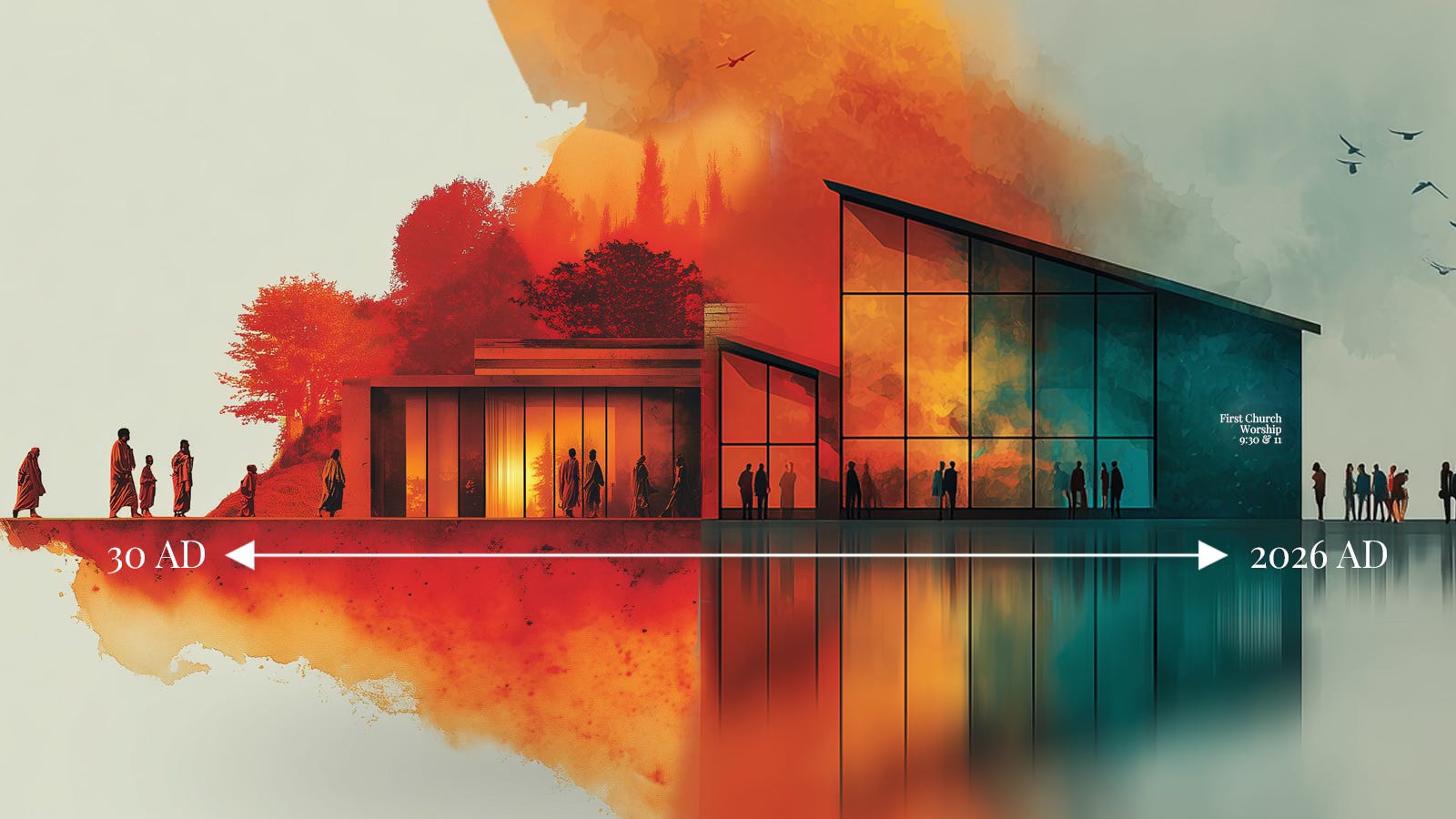
Something is missing.
I’ve seen it in my own life and in the lives of countless others I have known in thirty years of full-time Christian ministry. It’s a gap between what people have been told about Christianity and what they’re actually experiencing.
Maybe you’ve felt it too, whether you have been in church your whole life or you are just getting started with exploring faith questions.
Wherever you are, the question is the same:
How do I actually know Jesus?
Not know about Him, and definitely not just agree with correct principles about Him. I mean to actually know Him—the way you’d know your closest friend, the person you spend time with, learn from, and trust.
That’s the question More Like Jesus hopes to answer.
But to get there, we have to address a problem many of us don’t even realize exists.
The Order Problem
Here’s how most of us have been taught to grow as Christians:
Step 1: Join a church
Step 2: Attend worship and do programs and activities such as church initiatives, small groups, and Bible studies
Step 3: Learn church information such as theology, doctrine, and principles
Step 4: Apply what you learn to everyday life
Step 5: (Hopefully) experience transformation
This seems logical. Responsible, even. After all, you wouldn’t just follow someone without understanding who they are and what they teach, right?
Except that’s not how the first disciples learned to follow Jesus.
How the First Disciples Actually Learned
Open the Gospel of Mark and here is what you see:
Jesus walks by the Sea of Galilee and says to two fishermen: “Follow me.”
- Mark 1:16-17
Not “Come visit my synagogue this weekend.”
Not “Complete this study.”
Not “Let me share my theological framework with you.”
Just: Follow me.
And then later, this happens:
He appointed twelve that they might be with him and that he might send them out.
- Mark 3:14
Notice the order. What is the first thing that Jesus prioritizes?
Being with him.
In other words, proximity comes before mission.
Being comes before doing.
Formation comes before programs.
As Mark’s story progress, Jesus spends the next several chapters teaching His disciples through:
Letting them observe (healing, teaching, praying)
Encouraging them to try.. and fail (they can’t cast out demons, can’t understand parables, keep misunderstanding His mission)
Asking and answering questions (constantly confused)
Correcting them
The disciples don’t start with doctrine. They start with a Person. They don’t master theology. They follow… and understanding comes through proximity.
Something Gets Flipped
Fast forward two thousand years. The church—rightly wanting to ground people in truth and protect them from false teaching—now emphasizes information about Jesus.
In my experience with thousands of congregations across dozens of faith traditions, I see the same pattern almost everywhere. Here’s what we tend to do now in the church:
First understand the theology
Then participate in some programs
Then maybe you’ll experience transformation
We reversed the biblical order. And here’s the result:
You can study the Bible for years and still feel distant from God.
You can memorize principles and still wonder if any of it is real.
You can attend programs faithfully and follow all of the acronyms and still sense something’s missing.
Why? Because information—even information-based activity—doesn’t lead to transformation.
The Missing Ingredient: Proximity
Jesus didn’t give the disciples a curriculum. He gave them Himself.
For the first disciples, formation happened through proximity—being with Jesus as He lived, taught, healed, confronted, loved, suffered.
The disciples didn’t understand most of what Jesus said at first. They got things wrong constantly. As we will see in our journey through Mark’s story, Peter famously rebuked Jesus for talking about His death (Mark 8:32). James and John argued about who would sit at Jesus’ right hand in glory (Mark 10:37). They all abandoned Him when He was arrested (Mark 14:50).
By modern standards, they were terrible students.
But Jesus was patient. He kept inviting them closer. It’s clear from the stories that the transformation of the original twelve wasn’t about them acing a test. It was about them staying near Jesus long enough to be changed.
Transformation comes through proximity, not programs.
Biblical Order vs. Contemporary Order
Here’s what I see in the church today:
Contemporary Discipleship:
Church → Programs → Information → (Maybe) Formation
We start with the institution and hope it produces disciples. But here is the order the Gospel of Mark actually shows:
Apostle Discipleship (the Twelve):
Jesus → Proximity → Formation → Holy Spirit → Church
Notice how we’ve flipped it? Consider the biblical timeline:
Mark 1-16: Jesus forms disciples through three years of proximity
John 20 / Acts 1-2: The Spirit comes, first to the Twelve, then at Pentecost to birth the Church
Acts 2:42-47: The Church that emerges from formed disciples naturally creates rhythms of teaching, fellowship, communion, prayer
For us today, the pattern is different but follows the same principle:
Pentecost Discipleship (today):
The Story of Jesus → Faith/Holy Spirit → Proximity in Community → Formation
The consistent pattern is that the institution doesn’t create disciples; the story of Jesus creates disciples, and disciples become the Church. Here’s what this means practically:
When you encounter Jesus through His story—whether alone with Scripture, in a small group, or gathered with two or three others—that’s the church, and that’s where proximity happens. Formation emerges from that ongoing proximity to Jesus in community, not from institutional programs.
The biblical pattern starts with Jesus forming disciples through His story. Structure and programs can support that formation, but they can’t replace it. Rightly understood, the church is where proximity happens.
This begs the question: if proximity was key to the formation of the original twelve disciples, is it possible to recreate the same sense of proximity that the disciples experienced?
What More Like Jesus Offers
The claim of More Like Jesus is that it is indeed possible, and that the way is through proximity to Jesus through his story, experienced via Scripture and the Holy Spirit. This publication recovers the biblical order by inviting you to experience Jesus the way the first disciples did—through His story in Mark’s Gospel.
There’s no better way to see this pattern up close than by looking at Mark’s gospel, which most scholars agree is our oldest extant story of Jesus—the one closest to what actually happened. In fact, Mark was Simon Peter’s protégé. When we read Mark, we’re hearing Peter tell the actual story, about 25 years after it happened.
In this introductory volume and in the companion books and study editions coming soon, my goal is to help you experience Jesus the way the first disciples did.
Not by extracting principles from above the text or analyzing Jesus from a distance, but by inhabiting the story from within.
You’ll walk through Mark’s Gospel one moment at a time:
Standing on the shore when Jesus calls the first disciples
Watching Him heal people the religious leaders said couldn’t be healed
Sitting at the table with tax collectors and sinners
Hearing the Pharisees question His authority
Following Him up the mountain when He calls the twelve
You won’t just read about these moments. You’ll experience them. Feel them. Let them work on you from the inside.
In this study, I introduce an approach to help accomplish this goal: what I call Story Study. It’s not a technique or a new method, but a recovery of how the church engaged Scripture for 1,500 years, before we turned the Bible into a scientific document to dissect and analyze.
Story Study doesn’t give you principles extracted from Jesus’ story. It gives you the Jesus story itself. You’re not learning about Mark’s Gospel—you’re experiencing it the way Mark intended, as a living narrative that forms you through proximity.
No acronyms to memorize. No steps to master. No theological systems to decode. Just the story of Jesus, told in sequence, one moment at a time.
Story Study immerses you in biblical narrative through sensory, present-tense storytelling, then juxtaposes contemporary stories that echo the same truth, allowing formation to happen through discovery rather than explanation. The difference from traditional Bible study is crucial:
Traditional Bible study: Extract principles → Apply to your life → Measure progress
Story Study: Experience Jesus → Stay close → Let proximity transform you
Whereas most traditional studies treat Scripture as source material for teaching, Story Study treats Scripture as the actual place where you encounter Jesus. Mark’s Gospel isn’t content to analyze, but the space where formation happens.
Programs Aren’t the Enemy
Let me be clear: Programs aren’t bad.
Bible studies, small groups, theological training—these are valuable. Essential, even, for a mature faith.
But they work best after formation has begun through proximity to Jesus.
Think of it like learning to swim. You can read books about swimming. You can watch videos. You can memorize principles of buoyancy and stroke technique.
But eventually, you have to get in the water.
Programs are the books and videos. Proximity is getting in the water with Jesus.
Both matter. But one has to come first.
You might be wondering: If programs are part of the problem, why am I offering workbooks and a leader’s guide? Isn’t that just another program?
The difference is that traditional programs teach about Jesus. They typically offer principles, theology, application steps, and discussion questions. The content could be about anything—leadership, marriage, finances—with Jesus references added.
The Story Study approach aims to give you Jesus Himself. You’re not studying about Mark’s Gospel. You’re in Mark’s Gospel, experiencing what the first disciples experienced. The content isn’t derived from Jesus—it is Jesus, His actual story, told in the sequence Mark recorded it.
Traditional programs ask: “What can I learn from this passage to apply to my life?”
Story Study asks: “Who is Jesus in this moment, and what happens when I stay close to Him?”
The workbooks don’t teach you a technique to try or give you an acronym to memorize. They simply walk you through Mark’s Gospel, one story at a time, in the exact order Mark wrote it. The formation happens through proximity to Jesus in the narrative, not through steps to follow or principles to apply.
The curriculum is Mark’s Gospel.
Everything else in More Like Jesus—the contemporary stories, the reflections, the practices—exists only to help you stay close to Jesus as Mark reveals Him.
So yes, there are books. There’s a structure. There’s a leader’s guide. But the content isn’t my teaching about discipleship. It’s Mark’s telling of Jesus’ story. I’m just a guide creating space for you to encounter Him the way the first disciples did.
The goal is proximity, not a program.
Who This Is For
This is for you if:
You’ve been in church for years but still feel like you’re missing something
You’re exploring Christianity for the first time and don’t know where to start
You walked away from faith once, but you’re cautiously looking again
You love Jesus but struggle with “church people”
You’re tired of programs and principles and just want to know Him more
You’re a pastor or leader who senses something’s wrong with how we’re making disciples
Wherever you are in your journey, the invitation is the same:
Come experience Jesus through His story.
Not as information to master. As a Person to encounter.
What to Expect
The Story of Jesus, Act One
We begin with the story itself. You’ll experience the opening movement of Mark’s Gospel through immersive storytelling, from Jesus’ baptism through His early ministry, the calling of the twelve, and His teaching in parables.
You’ll read Mark 1:1 through 6:13, told in sequence, exactly as Mark wrote it. No rearranging passages to fit themes. No skipping verses that seem difficult. No extracting principles before you’ve experienced the story. Just the narrative, one moment at a time, letting Jesus reveal Himself the way He actually did to the first disciples.
Each entry in this volume includes:
The biblical story, told in present-tense narrative
A contemporary story that echoes the same truth
A brief reflection to help integration
Space for your response
Don’t rush. Let each story work on you. Notice what rises up—questions, resistance, recognition, hope.
Section Two: The Study of Story
After you experience Story Study, I explain how it works and why it’s different from traditional Bible study. You’ll understand:
Why story forms us in ways principles can’t
What makes Mark’s Gospel uniquely suited for discipleship
How this ancient practice was lost—and how to recover it
The difference between instrumental faith (using Jesus) and substantial faith (union with Christ)
One More Thing
You don’t need to have it all figured out to start.
You don’t need perfect theology. You don’t even need to be sure you believe.
The disciples didn’t have clarity when they started following Jesus. They were confused most of the time. They certainly didn’t “believe” the way we define belief today.
And Jesus was patient with them.
He’ll be patient with you too.
All you need is curiosity and a willingness to encounter Jesus through His story.
The transformation happens in the proximity.
Let’s get started.